Email support@vivrx.com seven days a week. Clinical questions go to your provider; we usually reply within one business day. In an emergency, call 911.
This Help Center provides general educational information about treatments offered through the VIV RX telehealth platform. It is not medical advice and does not replace the instructions of your prescribing provider or the pharmacy leaflet dispensed with your medication. Compounded medications are not FDA-approved and are not reviewed by the FDA for safety, effectiveness, or quality. Product names marked ® are trademarks of their respective owners.
What is VIV RX and how does it work?
About VIV RX · Reviewed September 2026
VIV RX is a telehealth platform that connects adults with independent, US-licensed providers for personalized weight-loss and wellness treatment, delivered to your door.
The three steps
Assess. Complete a short online medical intake about your goals, history, and current medications. It takes about five minutes and there is no charge.
Review. A US-licensed provider reviews your intake. If treatment is appropriate, they prescribe a plan; if not, they tell you why and what alternatives exist. You are only charged for medication if a prescription is issued.
Deliver. A licensed US pharmacy prepares and ships your medication in discreet packaging, with free delivery. Your provider stays available by email for questions, side effects, and dose changes.
What is included
Every monthly plan includes the provider evaluation, ongoing provider oversight, the medication itself, supplies where applicable, and shipping. There are no consultation fees, membership fees, or insurance requirements.
What VIV RX is not
VIV RX is not a medical practice, a pharmacy, or an emergency service. Care is provided by independent licensed clinicians and medication is dispensed by independent licensed pharmacies. If you think you are having a medical emergency, call 911.
Who reviews and prescribes my treatment?
About VIV RX · Reviewed September 2026
Every plan on VIV RX is reviewed by an independent, US-licensed clinician who is licensed in the state where you are located. They read your full medical intake, decide whether treatment is appropriate for you, choose the medicine and starting dose, and remain your point of contact for dose changes and side effects.
What they need from you
An honest, complete intake: every condition, every medication and supplement, allergies, pregnancy status, and past reactions.
Updates when anything changes: new prescriptions from another doctor, a new diagnosis, pregnancy, or a planned surgery.
Prompt reports of side effects, so the plan can be adjusted rather than abandoned.
Can I choose my provider or talk by video?
Care is delivered asynchronously by default: you write, your provider reviews and replies, usually within one business day. If your provider needs more information they will message you first, and they may request a call or lab work where clinically appropriate.
Are compounded medications FDA-approved?
About VIV RX · Reviewed September 2026
No. Compounded medications are not FDA-approved, and the FDA does not review them for safety, effectiveness, or quality before they are dispensed.
What compounding is
Compounding is when a state-licensed pharmacy prepares a medication for an individual patient based on a prescription, rather than dispensing a mass-manufactured product. It is legal and regulated at the state level, and compounding pharmacies must follow federal standards for how sterile preparations are made.
What that means for you
A compounded preparation is not the same as, and has not been evaluated by the FDA as equivalent to, any FDA-approved product.
For semaglutide and tirzepatide, FDA-approved medicines containing the same active ingredient exist (Wegovy®, Ozempic®, Zepbound®, Mounjaro®). Your provider can discuss whether one of those is a better fit for you.
For NAD+, sermorelin, glutathione, and the MIC + B12 blend, there is no FDA-approved equivalent product, and the evidence for their wellness uses is limited. Your provider will be candid about what is and is not established.
Compounded medications carry a beyond-use date rather than a manufacturer expiry, and storage instructions come from the pharmacy label.
Full risk information for every treatment is on our Safety Information page.
Where is VIV RX available?
About VIV RX · Reviewed September 2026
VIV RX is available to adults 18 and older who are located in the United States. Availability varies by state and by treatment, because provider licensing and pharmacy shipping rules differ from state to state. Your intake confirms eligibility for your state before any charge for medication. We cannot ship medication outside the United States or to a person other than the patient it was prescribed to.
How pricing and the $50 first-order offer work
About VIV RX · Reviewed September 2026
Every treatment is a flat monthly price that includes the provider review, ongoing oversight, medication, and shipping. There are no consultation fees, membership fees, or insurance claims. Current prices are listed on each treatment page in the shop.
The introductory offer
New patients receive $50 off their first order of any VIV RX treatment, weight loss or wellness, with code VIV50 at checkout. The discount applies to the first order only and cannot be combined with other offers. Renewals bill at the standard monthly price.
When you are charged
Nothing is charged for medication until a provider has reviewed your intake and issued a prescription. After that, your plan renews monthly at the price shown until you cancel. See how to pause or cancel and the Refund Policy.
How VIV RX protects my information
About VIV RX · Reviewed September 2026
Your medical intake, prescriptions, and messages are held on our secure enrollment and patient platform, not on this marketing website, which collects nothing. Your health information is handled under our Notice of Privacy Practices and Privacy Policy. California residents have additional rights described on the California Residents page, and you can adjust optional cookies at any time through the Privacy Choices link in the footer.
To request a copy of your records, correct information, or ask a privacy question, email support@vivrx.com from the address on your account.
How to contact VIV RX
About VIV RX · Reviewed September 2026
Email support@vivrx.com from the address on your account. Our care team reads messages seven days a week and usually replies within one business day. Clinical questions, side effects, and dose requests are routed to your provider. Please include your full name and, for medication issues, a photo of the pharmacy label.
VIV RX is not an emergency service. For a medical emergency, including trouble breathing, swelling of the face or throat, chest pain, severe stomach pain, fainting, or thoughts of harming yourself, call 911 or go to the nearest emergency room.
Compounded Semaglutide
Our Treatments · Weight Loss · Reviewed September 2026
A once-weekly GLP-1 receptor agonist injection that reduces appetite and slows digestion, prescribed for adults working toward meaningful weight loss.
What it is
Semaglutide mimics GLP-1, a gut hormone released after eating. It slows stomach emptying so you feel full longer, acts on appetite centres in the brain so you feel less hungry, and supports insulin release after meals. It is the same active molecule as the FDA-approved products Wegovy® and Ozempic®; the compounded version is prepared by a licensed pharmacy for your prescription and is not FDA-approved.
Who it may be for
Adults with excess weight, or weight-related health conditions, who have not reached their goals with lifestyle changes alone. Your provider decides eligibility from your intake. It is not for people with a personal or family history of medullary thyroid cancer or MEN 2, a history of pancreatitis, or who are pregnant, planning pregnancy, or breastfeeding.
What is included
Provider evaluation and ongoing oversight
A month of compounded semaglutide in a vial, with syringes and supplies
Free, discreet shipping in cold-chain packaging
Email access to your care team, seven days a week
Price
$199 per month, billed monthly until you cancel. New patients save $50 on the first order with code VIV50.
Our Treatments · Weight Loss · Reviewed September 2026
A once-weekly injection that activates two gut-hormone receptors, GLP-1 and GIP, to reduce appetite and support weight loss.
What it is
Tirzepatide is a dual GIP and GLP-1 receptor agonist. Like semaglutide it slows digestion and reduces hunger; the added GIP activity is thought to further influence appetite and how the body handles fat and sugar. It is the same active molecule as the FDA-approved products Zepbound® and Mounjaro®; the compounded version is not FDA-approved.
Who it may be for
Adults with excess weight who have not reached their goals with lifestyle changes alone, including those who have plateaued on other treatments. Your provider decides eligibility. The same thyroid, pancreatitis, gastrointestinal, and pregnancy cautions as other GLP-1 medicines apply, and birth-control pills may be less effective for a period after starting and after each dose increase.
What is included
Provider evaluation and ongoing oversight
A month of compounded tirzepatide in a vial, with syringes and supplies
Free, discreet cold-chain shipping
Email access to your care team, seven days a week
Price
$279 per month, billed monthly until you cancel. New patients save $50 on the first order with code VIV50.
Our Treatments · Weight Loss · Reviewed September 2026
A weekly GLP-1 weight-loss plan where your provider chooses the specific medicine after reviewing your intake.
How it differs
Rather than requesting semaglutide or tirzepatide by name, you enroll in a GLP-1 plan and your provider selects the medicine best suited to your history, other medications, and goals. Your pharmacy label names the medicine you receive, and its specific missed-dose, storage, and safety rules then apply. Read the semaglutide and tirzepatide overviews for both possibilities.
What is included
Provider evaluation, medicine selection, and ongoing oversight
A month of the compounded GLP-1 medicine your provider selects, with supplies
Free, discreet cold-chain shipping
Email access to your care team, seven days a week
Price
$199 per month, billed monthly until you cancel. New patients save $50 on the first order with code VIV50.
Our Treatments · Weight Loss · Reviewed September 2026
A compounded blend of three lipotropic compounds, methionine, inositol, and choline, with vitamin B12, prescribed as supportive therapy for energy and metabolism.
What it is
Lipotropics are involved in how the liver processes fat; vitamin B12 supports energy metabolism and red-blood-cell formation. The combination is compounded, is not FDA-approved for weight loss or any other use, and published evidence that it changes weight on its own is limited. It is best thought of as a supportive addition to nutrition, activity, and, where prescribed, a GLP-1 plan.
Who it may be for
Adults who want metabolic and energy support alongside a weight-loss effort, or whose provider identifies a benefit from B12. Not for people allergic to cobalt or B12, those with Leber's hereditary optic neuropathy, or without provider review if you have kidney, liver, or heart disease.
What is included
Provider evaluation and oversight
A month of MIC + B12 in a vial, with syringes and supplies
Free, discreet shipping
Email access to your care team
Price
$119 per month, billed monthly until you cancel. New patients save $50 on the first order with code VIV50.
Our Treatments · Wellness · Reviewed September 2026
Nicotinamide adenine dinucleotide, a coenzyme found in every cell and central to converting food into energy, given as a compounded subcutaneous injection.
What it is
NAD+ levels decline with age. Injected NAD+ is a compounded product, is not FDA-approved, and the human evidence for benefits such as energy, focus, or longevity is limited and mixed. Your provider will be candid about what is and is not established.
Who it may be for
Adults interested in cellular-energy support who understand the limited evidence. Not for pregnant or breastfeeding people, or without careful provider review if you have active cancer or serious heart, liver, or kidney disease.
What is included
Provider evaluation and oversight
A month of compounded NAD+ in a vial, with syringes and supplies
Free, discreet cold-chain shipping
Email access to your care team
Price
$179 per month, billed monthly until you cancel. New patients save $50 on the first order with code VIV50.
Our Treatments · Wellness · Reviewed September 2026
A synthetic fragment of growth-hormone-releasing hormone that prompts your own pituitary to release growth hormone in its natural nightly pulse.
What it is
Sermorelin does not supply growth hormone directly; it stimulates your body's own release, which is why it is injected at bedtime. The FDA-approved product was discontinued in 2008 for commercial reasons, so today's sermorelin is compounded, is not FDA-approved, and is not approved for recovery, sleep, body composition, or anti-aging. Evidence in healthy adults is limited.
Who it may be for
Adults interested in recovery and sleep support who understand the limited evidence. Not for anyone with a history of cancer, untreated thyroid disease, or who is pregnant or breastfeeding; diabetes, sleep apnea, and corticosteroid use need provider review.
What is included
Provider evaluation and oversight
A month of compounded sermorelin in a vial, with syringes and supplies
Free, discreet cold-chain shipping
Email access to your care team
Price
$159 per month, billed monthly until you cancel. New patients save $50 on the first order with code VIV50.
Our Treatments · Wellness · Reviewed September 2026
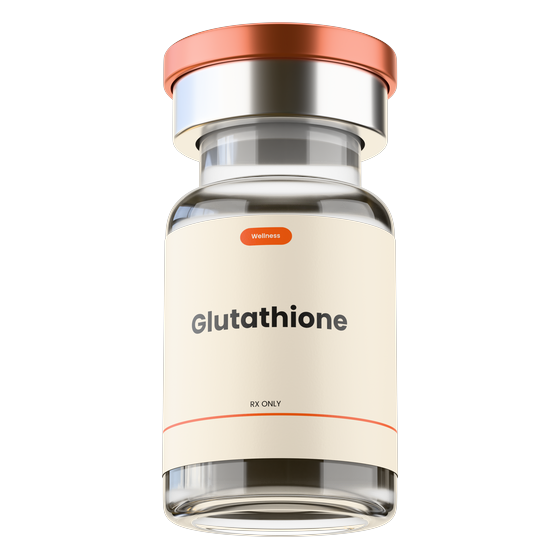
The body's principal intracellular antioxidant, given as a compounded subcutaneous injection for antioxidant support.
What it is
Glutathione is made from three amino acids and is involved in neutralizing reactive molecules and in liver detoxification pathways. Injected glutathione is compounded and is not FDA-approved for any use; evidence for benefits in healthy adults is limited. VIV RX positions it as antioxidant support only and makes no claims about skin, complexion, or disease.
Who it may be for
Adults interested in antioxidant support who understand the limited evidence. People with asthma, anyone receiving cancer treatment, and pregnant or breastfeeding people should not start it without specific provider review.
What is included
Provider evaluation and oversight
A month of compounded glutathione in a vial, with syringes and supplies
Free, discreet cold-chain shipping
Email access to your care team
Price
$149 per month, billed monthly until you cancel. New patients save $50 on the first order with code VIV50.
Treatment Administration Guide · Getting Started · Reviewed September 2026
Dose comes from your provider, not from this guide. These articles cover technique. The amount you draw up, how often you inject, and when your dose changes are set by your provider and printed on your pharmacy label. If the label and your provider's message disagree, stop and email support@vivrx.com before injecting.
Check what arrived
Most kits include the medication vial, insulin-style syringes with attached needles, and alcohol swabs. Kits vary by pharmacy. If anything is missing, damaged, or the vial arrived warm when it should have been cold, email us before using it.
Read the label twice
Confirm your name, the medication, the concentration (for example mg per mL), the dose in units or mL, how often to inject, storage instructions, and the beyond-use date. Keep the label; you will refer to it every time.
Inspect the medication
Most solutions are clear and colorless to slightly yellow; MIC + B12 is often pink or red. Do not use a vial that is cloudy, discolored beyond what your pharmacy describes, has particles floating in it, or is past its beyond-use date. Contact us for a replacement instead.
Set up your space
Choose a clean, flat, well-lit surface. Have your sharps container within reach before you start. If your medication is refrigerated, let the vial sit at room temperature for 10 to 15 minutes; a room-temperature injection stings less.
Treatment Administration Guide · Getting Started · Reviewed September 2026
All VIV RX injectables are given subcutaneously: a short, fine needle into the fatty layer just under the skin, not into muscle or a vein.
Shaded areas are the recommended sites. The black dot marks the navel: stay at least 2 inches (5 cm) away from it.
Abdomen (preferred). Anywhere on the belly at least 2 inches from the navel, avoiding the waistband line. Absorption is the most consistent here.
Front or outer thigh. The middle third of the thigh, between hip and knee. Easy to reach and see.
Back of the upper arm. The fatty area on the back of the arm, halfway between shoulder and elbow. Easiest if someone helps you.
Rotate every time
Move at least 1 inch (2.5 cm) from your last spot, and rotate between regions week to week. Repeated injections in one place can cause lumps, thickened skin, and uneven absorption. Never inject into skin that is bruised, tender, red, scarred, hard, or has a mole or tattoo. A simple note on your phone with the date and site makes rotation effortless.
Treatment Administration Guide · Getting Started · Reviewed September 2026
Set aside ten quiet minutes for your first few injections. Read every step once before you begin. Many people find it easier than they expected.
Prepare
Gather everything.
Your vial, one new syringe, two alcohol swabs, a cotton ball or gauze, and your sharps container, on a clean flat surface with good light. Let a refrigerated vial warm for 10 to 15 minutes.
Wash your hands.
Soap and warm water for 20 seconds, then dry with a clean towel. Do not touch the needle or the top of the vial after this point.
Check the vial.
Confirm the medication name and your dose against your label. Look at the liquid: clear, no particles, not expired. If you are opening a new vial, flip off the plastic cap. The rubber stopper underneath stays in place.
Clean the stopper.
Wipe the rubber top with an alcohol swab and let it air-dry for a few seconds. Do not blow on it or touch it afterwards.
Draw up the dose
Draw air into the syringe.
Remove the needle cap by pulling it straight off. Pull the plunger back to the number of units you will inject. This fills the syringe with the same volume of air as your dose.
Inject the air into the vial.
With the vial upright on the table, push the needle straight down through the centre of the stopper and press the plunger all the way in. Adding air stops a vacuum forming, which makes drawing up smoother.
Turn the vial upside down and draw your dose.
Keeping the needle inside, lift vial and syringe together and turn them upside down so the vial is on top. Make sure the needle tip is below the liquid level. Pull the plunger back slowly until the top of the black plunger stopper lines up exactly with your dose line. Draw a little extra if you see bubbles, then push back to the line.
Remove air bubbles.
Still upside down, tap the side of the syringe so bubbles rise to the needle. Gently push the plunger to send them back into the vial, then re-check your dose line. Small bubbles are not dangerous in a subcutaneous injection, but they take up space that should be medication.
Withdraw the needle.
Turn the vial upright and pull the needle straight out. Do not recap it, and do not set it down. Hold it like a pencil, needle pointing away from you.
Inject
Choose and clean your site.
Pick a spot using the rotation guidance. Wipe it with a fresh alcohol swab in a small circle and let it dry completely. Injecting through wet alcohol is what causes the sting.
Pinch and insert.
Gently pinch about an inch of skin and fat between thumb and fingers. In one smooth, quick motion, insert the needle all the way in at a 90-degree angle, straight in. If you are very lean, or your provider told you to, use 45 degrees instead. Quick beats slow; hesitating is what hurts.
Inject slowly, then count to five.
Release the pinch, then press the plunger down slowly and steadily until it stops. For NAD+ and glutathione, go especially slowly, following the time your provider specified. Hold the needle in place for about 5 seconds so the medication settles and does not leak back out.
Withdraw and press.
Pull the needle straight out at the same angle you inserted it. Press gently with a cotton ball or gauze for a few seconds. Do not rub; rubbing causes bruising and pushes medication out. A tiny drop of blood or a small red bump is normal.
Dispose of the syringe immediately.
Drop the whole syringe, needle first, into your sharps container without recapping. Never reuse a syringe or needle, even on yourself. Wipe the vial stopper, recap the vial if it has a cap, and return it to storage. Note the date, site, and dose.
Never share needles, syringes, or vials with anyone, even if the needle is changed. You could give or receive a serious infection.
Treatment Administration Guide · Getting Started · Reviewed September 2026
Units, mL, and mg are three different things
Most kits use insulin-style syringes marked in units. On a standard U-100 syringe, 100 units equals 1 mL, so 10 units is 0.1 mL and 50 units is 0.5 mL. The milligram (mg) dose your provider prescribes depends on your vial's concentration, which is why your label translates it into units or mL for you.
Units (U-100 syringe)
Volume
5 units
0.05 mL
10 units
0.10 mL
20 units
0.20 mL
25 units
0.25 mL
50 units
0.50 mL
100 units
1.00 mL
Never convert mg to units yourself. If your label gives only a milligram dose, email support@vivrx.com with a photo of the label and we will confirm the units before you inject.
Which line to read
Read the line that meets the top of the black plunger stopper, the flat edge closest to the needle, not the pointed tip and not the rubber's lower edge. Hold the syringe at eye level. Syringes come in 0.3 mL (30-unit), 0.5 mL (50-unit), and 1 mL (100-unit) sizes with different spacing between lines, so check what size you have before measuring: on a 0.3 mL syringe each small line is usually half a unit, on a 1 mL syringe each small line is usually 2 units.
How to inject Compounded Semaglutide
Treatment Administration Guide · Weight Loss · Reviewed September 2026
Schedule
Semaglutide is injected once a week, on the same day each week, at any time of day, with or without food. Pick a day you will remember, such as Sunday evening, and set a recurring reminder. You can change your injection day as long as your last dose was at least 2 days ago.
Technique
Follow the step-by-step guide. Abdomen, thigh, and upper arm are all appropriate. Rotate sites every week.
Dose changes
Providers typically start at a low dose and increase it gradually over weeks or months to let your body adjust. Never increase on your own, and never draw up more than your label states because you feel a dose "isn't working." Report side effects instead; the plan can be adjusted.
Missed dose
Based on FDA-approved semaglutide labeling: if your next scheduled dose is more than 2 days (48 hours) away, take the missed dose as soon as you can. If it is less than 2 days away, skip it and resume on your regular day. If you have missed two or more doses in a row, contact your provider before restarting; restarting at a lower dose may be needed.
Storage
Keep refrigerated at 36 to 46°F (2 to 8°C) unless your pharmacy label says otherwise. Do not freeze. Protect from light. Discard after the beyond-use date on the label even if medication remains.
Treatment Administration Guide · Weight Loss · Reviewed September 2026
Schedule
Tirzepatide is injected once a week, on the same day each week, at any time of day, with or without food. You may change your injection day as long as at least 3 days (72 hours) have passed since your last dose.
Technique
Follow the step-by-step guide. Rotate between abdomen, thigh, and upper arm every week.
Dose changes
Tirzepatide is usually started low and increased in steps no sooner than every 4 weeks, at your provider's direction. Do not increase on your own.
Missed dose
Based on FDA-approved tirzepatide labeling: take it as soon as possible within 4 days (96 hours) of the missed dose. If more than 4 days have passed, skip it and resume on your regular day. Never take two doses within 3 days of each other.
Birth control
If you take birth-control pills, use a non-oral method or add a barrier method for 4 weeks after starting and for 4 weeks after every dose increase, because tirzepatide can reduce how well the pill is absorbed.
Storage
Refrigerate at 36 to 46°F (2 to 8°C) unless the label says otherwise. Do not freeze. Protect from light.
How to inject Compounded GLP-1 (provider-selected)
Treatment Administration Guide · Weight Loss · Reviewed September 2026
Your provider selects the specific GLP-1 medicine after reviewing your intake, and your pharmacy label names it. Once you know which medicine you received, follow the semaglutide or tirzepatide guide for schedule, missed-dose, and storage rules, because they differ between the two. The injection technique itself is identical: once weekly, subcutaneous, rotating sites.
If your label does not clearly name the medication, do not inject. Email support@vivrx.com with a photo of the label and we will confirm.
How to inject MIC + B12
Treatment Administration Guide · Weight Loss · Reviewed September 2026
Schedule
MIC + B12 is most often prescribed once or twice a week; your label states your frequency. Some people prefer a morning injection; follow your label if it specifies a time.
Technique
Follow the step-by-step guide. Your provider may specify subcutaneous or intramuscular; unless the label says intramuscular, inject subcutaneously. The solution is often pink or red from the B12; that is normal.
What to expect
A brief stinging or warm feeling at the site is common, and some people notice a faint fishy body odor for a few hours from the choline. Injection-site soreness usually resolves within a day.
Missed dose
Take it when you remember unless your next dose is due within a day or two; in that case skip it. Do not double up.
Storage
Follow your label. Many MIC + B12 preparations are refrigerated and protected from light, because B12 degrades with light exposure.
Treatment Administration Guide · Wellness · Reviewed September 2026
Schedule
Frequency varies widely by protocol; follow your label exactly. Some plans begin with smaller, more frequent doses and build up.
Go slowly
This is the single most important point for NAD+. Injecting quickly can cause flushing, nausea, cramping, chest tightness, or lightheadedness. Press the plunger over the time your provider specified, often 30 to 60 seconds or longer for larger volumes. Sit or lie down for your first several doses, and have water nearby.
If symptoms start mid-injection, pause with the needle in place, breathe, and wait for the feeling to pass before continuing more slowly. If chest tightness or faintness does not pass within a few minutes, withdraw the needle and seek care.
Technique
Subcutaneous, abdomen or thigh, using the step-by-step guide. Rotate sites. Some patients find splitting a larger volume across two sites more comfortable; ask your provider before doing so.
Missed dose
Take it when you remember unless your next dose is close; then skip it and continue your usual schedule. Do not double up.
Storage
NAD+ is sensitive to heat and light. Keep refrigerated and protected from light unless your label directs otherwise. Discard if the solution darkens or turns cloudy.
Treatment Administration Guide · Wellness · Reviewed September 2026
Timing matters
Sermorelin is normally injected at bedtime, on an empty stomach, at least 90 minutes to 2 hours after your last meal. The body's own growth-hormone release peaks in early deep sleep, and food, especially carbohydrates and fat, blunts the response. Follow the frequency on your label; many plans are nightly, sometimes with rest days.
Technique
Subcutaneous, using the step-by-step guide. Abdomen and thigh are typical sites. Rotate nightly.
What to expect
Mild redness or a small itchy bump at the site is common and fades within hours. Some people feel flushed or notice vivid dreams early on. Report joint pain, hand or foot swelling, or tingling fingers to your provider.
Missed dose
Skip it and take your next dose at the usual time. Do not double up.
Storage
Refrigerate and protect from light unless your label says otherwise. Do not freeze.
Treatment Administration Guide · Wellness · Reviewed September 2026
Schedule
Follow the frequency on your label; one to three times a week is a common range.
Technique
Subcutaneous, using the step-by-step guide. Inject slowly. Rotate between abdomen and thigh. Glutathione can occasionally sting more than other injections; a room-temperature vial and a fully dry site help.
What to expect
Mild cramping, bloating, or loose stools within a day of a dose happen in some people and usually pass. Tell your provider about any wheezing or shortness of breath immediately, particularly if you have asthma.
Missed dose
Take it when you remember unless your next dose is close; then skip. Do not double up.
Storage
Glutathione oxidizes with heat, light, and air. Refrigerate, protect from light, and discard if it discolors or clouds.
Refrigerate at 36 to 46°F (2 to 8°C) unless your pharmacy label says otherwise. Store in the original box to protect from light, away from the freezer compartment and the door shelf where temperatures swing. Never freeze; a vial that has frozen should be discarded. Keep out of reach of children and pets.
Beyond-use date
Compounded medications carry a beyond-use date rather than a manufacturer expiry. Once you puncture the stopper, the label may give a shorter in-use period. Write the date you first opened the vial on the box. Discard any remaining medication after the earlier of the two dates, even if it looks fine.
Travelling
Carry medication in your hand luggage, never checked baggage. Use an insulated pouch with a cold pack; do not let the vial touch the ice directly. Keep the pharmacy label with it. Medically necessary liquids and syringes are permitted through TSA screening in any quantity if you declare them. Ask your pharmacy how long your specific medication is stable at room temperature.
Left it out overnight? Do not guess. Email support@vivrx.com with the medication name and how long it was unrefrigerated. Many preparations tolerate hours at room temperature; some do not, and the pharmacy will tell you.
An FDA-cleared sharps container is best; pharmacies and online retailers sell them for a few dollars. If you do not have one, a heavy-duty plastic container with a screw-on lid, such as an empty laundry-detergent bottle, works. Label it "SHARPS, DO NOT RECYCLE." Never use glass, thin plastic, or anything that can be punctured, and never throw loose needles in household trash or recycling.
When it is three-quarters full
Seal the lid with tape. Disposal rules vary by state and city: options usually include pharmacy or hospital drop-off, household hazardous-waste sites, mail-back programs, and, in some places, sealed containers in household trash. Check your local rules at safeneedledisposal.org or your city's waste site.
Injection troubleshooting
Treatment Administration Guide · Troubleshooting · Reviewed September 2026
A drop of blood or a bruise
A drop of blood means you nicked a tiny surface vessel; press for 30 seconds with gauze. Bruises are cosmetic and fade in a week. To reduce them: let alcohol dry fully, insert quickly, do not rub afterwards, and avoid injecting near visible veins. Persistent large bruises, or bruising with easy bleeding elsewhere, should be mentioned to your provider.
Medication leaked out
A tiny bead at the surface is normal and does not need making up. If a noticeable amount leaked, do not re-inject; you cannot know how much went in, and a double dose is riskier than a slightly low one. Note it, continue your usual schedule, and email us if it keeps happening. Holding the needle in for 5 seconds and releasing the pinch before pressing the plunger both reduce leaks.
An air bubble I could not remove
In a subcutaneous injection a small bubble is harmless; it simply means your dose is a fraction low. If the bubble is large, push the medication back into the vial, redraw, and tap again with the syringe vertical, needle up.
A lump, redness, or itching at the site
A firm pea-sized lump or a warm, itchy red patch that appears within a day and fades within a few days is a common local reaction. A cool compress helps. Rotate away from that area until it resolves. Contact your provider if redness spreads, the area becomes hot and increasingly painful, you see pus, or you develop a fever; those can be signs of infection.
It hurts more than expected
Common causes: injecting cold medication (let the vial warm 10 to 15 minutes), injecting through wet alcohol, inserting slowly, tensing the muscle beneath the site, or injecting into a scarred or overused area. Numbing the spot with an ice cube for 30 seconds before cleaning also helps. Pain that is sharp, radiating, or lingers for hours should be reported.
The needle bent, or I touched it
Discard that syringe in your sharps container and start over with a new one. A bent needle can break, and a touched needle is no longer sterile. Never try to straighten or clean a needle.
I dropped or broke the vial
If the glass is intact and the stopper is still sealed, wipe it and inspect the liquid for particles before using. If it cracked or leaked, wrap it in paper towel, place it in your sharps container or a sealed bag, and email us for a replacement. Do not draw up from a cracked vial.
Nervous about needles?
Treatment Administration Guide · Troubleshooting · Reviewed September 2026
You are not alone; needle anxiety is common when starting any self-injected treatment. The needles in your kit are short and very fine, and the injection goes into fat, not muscle. The first injection is usually the hardest; it tends to get easier with practice.
Use the abdomen, where the skin is least sensitive, and let the vial warm to room temperature.
Numb the spot with an ice cube for 30 seconds before cleaning it.
Exhale slowly as you insert; a quick, confident motion hurts less than a slow one.
Sit somewhere comfortable, put on something you enjoy, and plan a small reward afterwards.
Ask a partner or friend to help with the first few, or to inject the upper arm for you.
If you are still struggling after a few weeks, tell your provider. There may be options.
A patient's guide to GLP-1 medications for weight loss
Patient Education · Weight Loss · Reviewed September 2026
How they work
GLP-1 is a hormone your gut releases after eating. Medicines like semaglutide mimic it: they slow how quickly food leaves the stomach so you feel full longer, act on appetite centres in the brain so you feel less hungry and less preoccupied with food, and help the pancreas release insulin in response to meals. Tirzepatide additionally activates GIP, a second gut hormone. The result for most people is eating less without feeling deprived.
The first weeks
Providers start low and increase gradually. Early on, the most noticeable effects are usually reduced appetite and mild nausea, especially after a dose increase. Weight change in the first month is often modest; the medication's effect builds over months, and the dose you settle on is more important than how fast you get there.
Hydration and alcohol
Dehydration from reduced intake, vomiting, or diarrhea is the most common route to kidney problems on these medicines, so keep fluids up even when you are not thirsty. Alcohol hits harder on a slowed stomach, worsens nausea, and increases the risk of low blood sugar; keep it minimal.
Other medicines and procedures
Tell every clinician you take a GLP-1, especially before any surgery or sedation, because a slowed stomach changes anesthesia planning. Other prescriptions, such as blood-pressure and diabetes medicines, may need adjusting as you lose weight.
When to contact your provider
Nausea or vomiting that stops you keeping fluids down, any severe stomach pain, signs of low blood sugar, changes in vision or mood, or anything that worries you. Call 911 for symptoms of a severe allergic reaction, severe persistent abdominal pain, or chest pain. See signs that need urgent care.
Managing GLP-1 side effects
Patient Education · Weight Loss · Reviewed September 2026
Nausea
Eat smaller meals, stop when you feel satisfied rather than full, avoid greasy or very sweet foods, keep bland snacks handy, and stay upright after eating. Ginger and peppermint help many people. Nausea typically fades within days of each dose step; if it does not, or if you are vomiting, tell your provider. Your dose can be held or reduced.
Constipation
Slower digestion makes this common. Drink water steadily through the day, aim for fiber from vegetables and whole grains, walk after meals, and ask your provider about a gentle over-the-counter option if needed. Do not let it go more than a few days without mentioning it.
Reflux and burping
Avoid large late meals and lying down soon after eating. Smaller portions and fewer carbonated drinks reduce both. Persistent heartburn is worth a message to your provider.
Fatigue and lightheadedness
Often a sign you are eating or drinking too little, or that blood pressure has dropped as weight comes off. Check you are getting enough fluids, salt, and protein, and stand up slowly. Report dizziness that persists, or any fainting.
Hair shedding
Temporary shedding can follow rapid weight loss with any method. It usually resolves as weight stabilizes. Adequate protein helps.
When side effects are not "normal"
Severe or persistent stomach pain, vomiting that prevents fluids, yellowing skin or eyes, a lump in the neck, vision changes, or mood changes are not routine side effects. See signs that need urgent care and contact your provider.
Understanding dose titration
Patient Education · Weight Loss · Reviewed September 2026
Titration means starting at a low dose and increasing it in planned steps. GLP-1 medicines are titrated because the stomach-related side effects are strongest when the body first meets a new dose level; stepping up gradually lets the gut adapt and keeps most people comfortable enough to continue.
What a typical schedule looks like
Your provider sets your schedule, and it is printed on your label. In general, each step lasts at least four weeks before the next increase, and not everyone reaches the highest dose; many people stay at the step where appetite control and tolerability balance. Slowing down or pausing a step because of side effects is normal and does not mean the treatment is failing.
What you should never do
Increase your own dose because a week felt "weak."
Skip steps to catch up with someone else's schedule.
Combine two vials or two GLP-1 medicines.
Restart at your old dose after a break of two or more missed weeks without asking your provider.
Message your provider before each planned increase if you have any lingering side effects; they may hold you at the current step a little longer.
A patient's guide to Compounded Semaglutide
Patient Education · Weight Loss · Reviewed September 2026
Semaglutide is a once-weekly GLP-1 receptor agonist. It is the same active molecule as the FDA-approved products Wegovy® and Ozempic®; the compounded version is prepared by a licensed pharmacy for your prescription and is not FDA-approved or reviewed. Your provider will discuss whether an FDA-approved option is appropriate for you.
What to expect
Appetite reduction is usually noticeable within the first one to two weeks. Stomach-related side effects cluster around dose increases and usually fade. Most people's dose is increased in steps over several months to reach the level that works for them.
Who it may not suit
People with a personal or family history of medullary thyroid cancer or MEN 2, a history of pancreatitis, severe stomach or bowel disease, or who are pregnant, planning pregnancy, or breastfeeding. Semaglutide should be stopped at least 2 months before trying to conceive. Full details are in the safety information.
Patient Education · Weight Loss · Reviewed September 2026
Tirzepatide is a once-weekly dual GIP and GLP-1 receptor agonist. It is the same active molecule as the FDA-approved products Zepbound® and Mounjaro®; the compounded version is not FDA-approved or reviewed. Your provider will discuss whether an FDA-approved option is appropriate for you.
What to expect
Appetite and food-related thoughts usually decrease within the first weeks. Nausea, diarrhea, and constipation are the most common side effects and are most likely after a dose step. Some people notice hair shedding during rapid weight loss, which typically resolves.
Birth control
Tirzepatide can reduce how well birth-control pills are absorbed. Use a non-oral method, or add a barrier method, for 4 weeks after starting and after each dose increase.
Who it may not suit
The same thyroid, pancreatitis, gastrointestinal, and pregnancy cautions as other GLP-1 medicines apply. Full details are in the safety information.
Semaglutide vs. tirzepatide: how does my provider choose?
Patient Education · Weight Loss · Reviewed September 2026
Both are weekly injections that reduce appetite through gut-hormone pathways. Semaglutide acts on the GLP-1 receptor alone; tirzepatide acts on both GLP-1 and GIP receptors. In the manufacturers' clinical trials of the FDA-approved products, both produced meaningful weight loss, with tirzepatide producing more on average, and the side-effect profiles are broadly similar.
Semaglutide
Tirzepatide
Mechanism
GLP-1 receptor agonist
Dual GIP / GLP-1 receptor agonist
Schedule
Once weekly
Once weekly
Missed-dose window
Take if next dose is more than 48 h away
Take within 96 h of the missed dose
Birth-control note
None specific
Add barrier method for 4 weeks after start and each increase
VIV RX price
$199 / month
$279 / month
Your provider weighs your history, other medications, prior experience with either medicine, tolerance, and cost. Individual results vary, and the right medicine is the one you can take consistently and tolerate well. If you are prescribed Compounded GLP-1, your provider has made that selection for you and your label names it.
A patient's guide to MIC + B12
Patient Education · Weight Loss · Reviewed September 2026
MIC + B12 combines three lipotropic compounds, methionine, inositol, and choline, with vitamin B12. Lipotropics are involved in how the body processes fat in the liver; B12 supports energy metabolism and red-blood-cell formation. The combination is compounded and is not FDA-approved for weight loss or any other use, and published evidence that it changes weight on its own is limited. It is best thought of as a supportive addition to nutrition, activity, and, where prescribed, a GLP-1 plan.
What to expect
Any effect on energy is most plausible if your B12 was low; evidence for other benefits is limited. Injection-site soreness and a brief fishy body odor from choline are the most common side effects.
Who should be cautious
Anyone allergic to cobalt or B12, people with Leber's disease, and those with kidney, liver, or heart disease. See the safety information and how to inject MIC + B12.
A patient's guide to NAD+
Patient Education · Wellness · Reviewed September 2026
NAD+ (nicotinamide adenine dinucleotide) is a coenzyme found in every cell, central to converting food into energy and to DNA repair. Levels decline with age. Injected NAD+ is a compounded product, is not FDA-approved, and the human evidence for benefits such as energy, focus, or longevity is limited and mixed; your provider will be candid about what is and is not established.
What to expect
Experiences vary widely and benefits are not established by evidence. The most consistent short-term effects are the injection-related ones: flushing, nausea, or a tight chest if it is injected quickly, which is why the technique guide emphasizes going slowly.
Who should be cautious
Pregnant or breastfeeding people, anyone with active cancer or serious heart, liver, or kidney disease, and anyone already taking NAD-precursor supplements such as NMN, nicotinamide riboside, or high-dose niacin. See the safety information and how to inject NAD+.
A patient's guide to Sermorelin
Patient Education · Wellness · Reviewed September 2026
Sermorelin is a synthetic fragment of growth-hormone-releasing hormone. Rather than supplying growth hormone directly, it prompts your own pituitary gland to release it in its natural nightly pulse, which is why it is taken at bedtime. The FDA-approved product was discontinued in 2008 for commercial reasons; today's sermorelin is compounded, is not FDA-approved, and is not approved for recovery, sleep, body composition, or anti-aging. Evidence in healthy adults is limited.
What to expect
Any effects, if they occur, build slowly over weeks to months, not days, and are not established by evidence in healthy adults. Early side effects are usually limited to the injection site, flushing, or headache.
Who should be cautious
Anyone with a history of cancer, untreated thyroid disease, diabetes, or sleep apnea, and anyone taking corticosteroids. Report joint pain, hand or foot swelling, or tingling fingers, which can signal too much growth-hormone activity. See the safety information and how to inject sermorelin.
A patient's guide to Glutathione
Patient Education · Wellness · Reviewed September 2026
Glutathione is the body's principal intracellular antioxidant, made from three amino acids, and is involved in neutralizing reactive molecules and in liver detoxification pathways. Injected glutathione is compounded and is not FDA-approved for any use; evidence for benefits in healthy adults is limited. VIV RX positions it as antioxidant support only and does not make claims about skin, complexion, or disease.
What to expect
There is usually no immediate sensation beyond the injection itself. Mild cramping or loose stools after a dose occur in some. Because glutathione oxidizes readily, storage and prompt use matter more than with most treatments.
Who should be cautious
People with asthma, anyone receiving cancer treatment, and pregnant or breastfeeding people. The FDA has cautioned about injectable glutathione compounded from non-sterile powder, so ask how yours is prepared. See the safety information and how to inject glutathione.
Eating well on a GLP-1: a practical plan
Patient Education · Living With Treatment · Reviewed September 2026
Build each meal around protein
Eggs, fish, poultry, Greek yogurt, tofu, and legumes first, then vegetables, then whole grains or fruit. When appetite drops, protein is the nutrient most easily neglected, and losing weight without maintaining muscle leaves you weaker and can slow your metabolism.
Eat slowly and stop at satisfied
A slowed stomach punishes overeating with nausea. Smaller plates, slower bites, and a pause before seconds all help.
Fluids and fiber
Drink water steadily through the day, more if you exercise or the weather is hot. Keep fiber up from vegetables and whole grains to counter constipation.
Limit the nausea triggers
Alcohol, fried food, and very sweet food are the three most reliable triggers. Keep them minimal, especially in the week after a dose increase.
Move daily and lift twice a week
Walking after meals aids digestion; resistance exercise two or three times a week protects muscle. Rapid weight loss on very low intake is not a goal. If you are struggling to eat enough, tell your provider.
Check-ins, labs, and monitoring
Patient Education · Living With Treatment · Reviewed September 2026
Your provider reviews your progress and side effects at renewal and whenever you message. Depending on your history and treatment, they may ask for blood-pressure readings, weight logs, or lab work from a local laboratory before continuing or increasing a dose.
Keep a simple log
A weekly note of weight, injection date and site, dose, and any side effects makes check-ins faster and your care better. A phone note or a paper calendar on the fridge both work.
Tell us about changes
New prescriptions from another doctor, a new diagnosis, pregnancy or plans for it, or an upcoming surgery all matter to your plan. Message your provider as soon as you know.
Signs that need urgent care
Patient Education · Living With Treatment · Reviewed September 2026
Call 911 or go to the nearest emergency room for swelling of the face, lips, tongue, or throat; trouble breathing or swallowing; severe persistent stomach or back pain, with or without vomiting; chest pain; fainting; or thoughts of harming yourself.
Contact your provider the same day
Vomiting or diarrhea that prevents you keeping fluids down
A lump in the neck, hoarseness, or trouble swallowing
Yellowing of the skin or eyes, or pale stools
Changes in vision
Signs of low blood sugar: shakiness, sweating, confusion, fast heartbeat
A fever with an injection site that is hot, spreading, or leaking
New or worsening low mood
VIV RX is not an emergency service. Email is read seven days a week, but it is not monitored in real time.
Telling other clinicians about your treatment
Patient Education · Living With Treatment · Reviewed September 2026
Add your VIV RX medications to the list you give every doctor, dentist, pharmacist, and anesthesia team. GLP-1 medicines in particular change how oral medicines are absorbed and require specific planning before procedures with sedation, because a slowed stomach raises the risk of food entering the lungs. Blood-pressure and diabetes medicines often need adjusting as weight comes off. If you become pregnant or plan to, tell your VIV RX provider immediately.
How do I sign in to my patient portal?
Account Management · Reviewed September 2026
Go to patient.vivrx.com and enter the email address you used when you enrolled. Follow the prompts to verify your identity. If you cannot sign in or no longer have access to that email, contact support@vivrx.com from your new address and we will verify you and update your account.
How does my subscription work?
Account Management · Reviewed September 2026
Every VIV RX plan is a monthly subscription at the price shown when you enrolled. It renews automatically each month until you cancel, and each renewal includes your medication, provider oversight, and shipping. There are no separate consultation or membership fees. Your first order of any VIV RX treatment is eligible for the $50 introductory discount with code VIV50; renewals bill at the standard price.
When will my order ship, and how do I track it?
Account Management · Reviewed September 2026
Your first order ships after a licensed provider reviews your intake and approves a prescription; nothing is charged for medication before that. Refrigerated medications ship in insulated packaging with cold packs, and a tracking link is emailed when the parcel leaves the pharmacy. If a delivery is late, damaged, or arrived warm, email us the same day so we can arrange a replacement.
How do I update my shipping address or payment method?
Account Management · Reviewed September 2026
Sign in to patient.vivrx.com to update your address and payment details before your next renewal date. If the option is not visible for your plan, email support@vivrx.com and we will update it for you. Because medication is prescribed to you personally, we cannot ship to a different person or to a state where the service is not available.
How do I pause or cancel?
Account Management · Reviewed September 2026
Email support@vivrx.com from the address on your account and tell us whether you want to pause or cancel. There is no cancellation fee. To avoid being billed for the next month, send your request before your renewal date; orders that have already shipped cannot be recalled. See the Refund Policy for how refunds are handled.
If you are stopping a GLP-1 medicine, let your provider know too. They may suggest a taper or a check-in, and it helps them adjust any other prescriptions.
Can I change my dose or switch treatments?
Account Management · Reviewed September 2026
Dose changes and treatment switches are medical decisions made by your provider. Email your care team describing what you are experiencing (side effects, plateau, schedule problems) and your provider will review and respond, usually within one business day. Never adjust your own dose from the vial. See understanding dose titration.
How do refills work, and what if something is wrong with my medication?
Account Management · Reviewed September 2026
Refills are sent automatically with each renewal after your provider's ongoing review. If you are running short because a dose was changed, a vial was damaged, or a shipment was lost, email us and we will coordinate with the pharmacy. Include a photo of the label where relevant. Do not use a vial that is cloudy, discolored, contains particles, or arrived warm; set it aside and contact us.
How is my health information protected, and how do I get my records?
Enter VIV50 in the promo-code field at checkout on your first order of any VIV RX treatment. $50 is deducted from that first order only. The code does not apply to renewals or in combination with other offers. If the field did not accept the code, email us before your first charge and we will apply it manually.